1. A semiconductor device has a built-in junction capacitor.
However, when a reverse voltage starts to rise during the turn-off phase, this capacitance is insufficient to reduce any overvoltage. An additional parallel RC-snubber is then needed to reduce the overvoltage to a reasonable limit.
Snubber component design depends on the operating conditions including commutation inductance, voltage and diT/dt during turn-off. Other factors to consider include the semiconductor’s reverse current waveform during operation and its circuit conditions. The snubber also influences the semiconductor’s turn-off losses.
2. Snubber operation in 6-pulse converter bridge configuration
The following discussion focuses on thyristors, rather than on diodes. This is because thyristors are a generalization of both device types. The freedom in selecting firing angles is not an option for diodes. Furthermore, the overvoltage considerations for thyristor bridges with full firing angle control and diode bridges are somewhat different.
Any influences from stray inductances in the snubber branches are neglected. This is acceptable, provided low inductive RC-snubber design is used. In applications such as AC switches, the thyristors have individual RC-snubbers that do not interact with other RC-snubbers at turn-off. For the common 6-pulse bridge configuration, the RC-snubbers will communicate with each other at turn-off, if each thyristor has its own RC-snubber. Here we look at the influence, at turn-off, of thyristor 1 in Fig. 16.
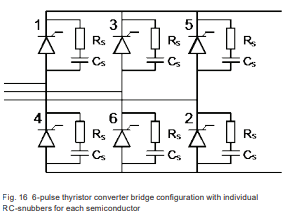
At turn-off of thyristor 1, thyristors 2 and 3 are conducting and are thus short-circuiting their RC-snubbers. However, thyristors 4, 5 and 6 are blocking and thus their RC-snubbers influence the turn-off of thyristor 1. For this turn-off phase we get an equivalent circuit as shown in Fig. 17.
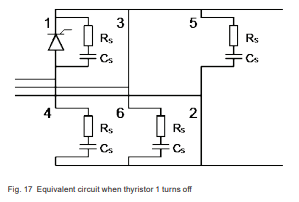
In Fig. 17, the RC-snubbers of thyristors 5 and 6 are now connected in parallel. This parallel connection is in series with the RC-snubber of thyristor 4. Simplifying Fig. 17 we arrive at Fig. 18.

Using standard formulae for parallel and series connection of resistors and capacitors, thyristor 1 at turn-off sees an RC-snubber with equivalent resistance and capacitance Req and Ceq which can be expressed by the component values Rs and Cs as:

For calculation of the overvoltage peak for 6-pulse bridges, Req and Ceq should be used in the formula and the discrete component values Rs and Cs can then be calculated from Eqn. 7 and 8. Due to the nature of the 6-pulse bridge, the thyristor and the snubber circuit will see voltage spikes coming from the commutation of the other thyristors in the bridge. The voltage spikes depend on the firing angle and will be largest at a firing angle of 90°. Thyristor 1, for example, will in addition to its own turn-on and turn-off, also see overvoltage spikes from the turn-off of thyristors 3, 4 and 6. The voltage spikes from turn-off of 4 and 6, however, will not affect the voltage stress of the thyristor, since they appear at low voltage levels. The turn-off of thyristor 3 will not affect the voltage stress of the device either, but it has a significant impact on the RC-snubber losses.
3. Snubber design calculation example An example for calculating the snubber is as follows: The B6 pulse bridge shown in Fig. 19 features phase control thyristors of voltage class 6500 V, 5STP 26N6500. Following snubber design requirements from the application are given: • The maximum reverse voltage commutation is VR = 3000 V and the maximum overvoltage shall be VRM < 6300 V as design requirement • Therefore, VRM/VR < 2.1 • The commutation inductance Lc = 2*Ls = 500 µH, therefore the diT/dt = VR/Lc = 6 A/µs

The value of the peak reverse recovery current is to
read out at diT/dt = 6 A/μs from the data sheet maxcurve of IRM vs. -diT/dt (Fig. 20): IRM = 250 A.


6. Conclusions
Electrical stresses (reverse overvoltage) on a phase control device or rectifier diode caused during switching can be reduced using snubber circuits, to levels that are within the device’s electrical ratings. Snubber circuits also influence the power loss in the semiconductor. However, they cause losses of their own due to the need to discharge the capacitor before the next semiconductor turn-off. Design and snubber component selection, also for 6-pulse bridge design, are described in detail.
https://eigbt.com/ABB.html
Contact: Vicky
Phone: 86-13410359515
E-mail: [email protected]
Add: D1,6th Floor,Tower 13,Lehui Center,Jihua Roard 489, Longgang District, Shenzhen, China
